Gas conditions from CO isotopologues
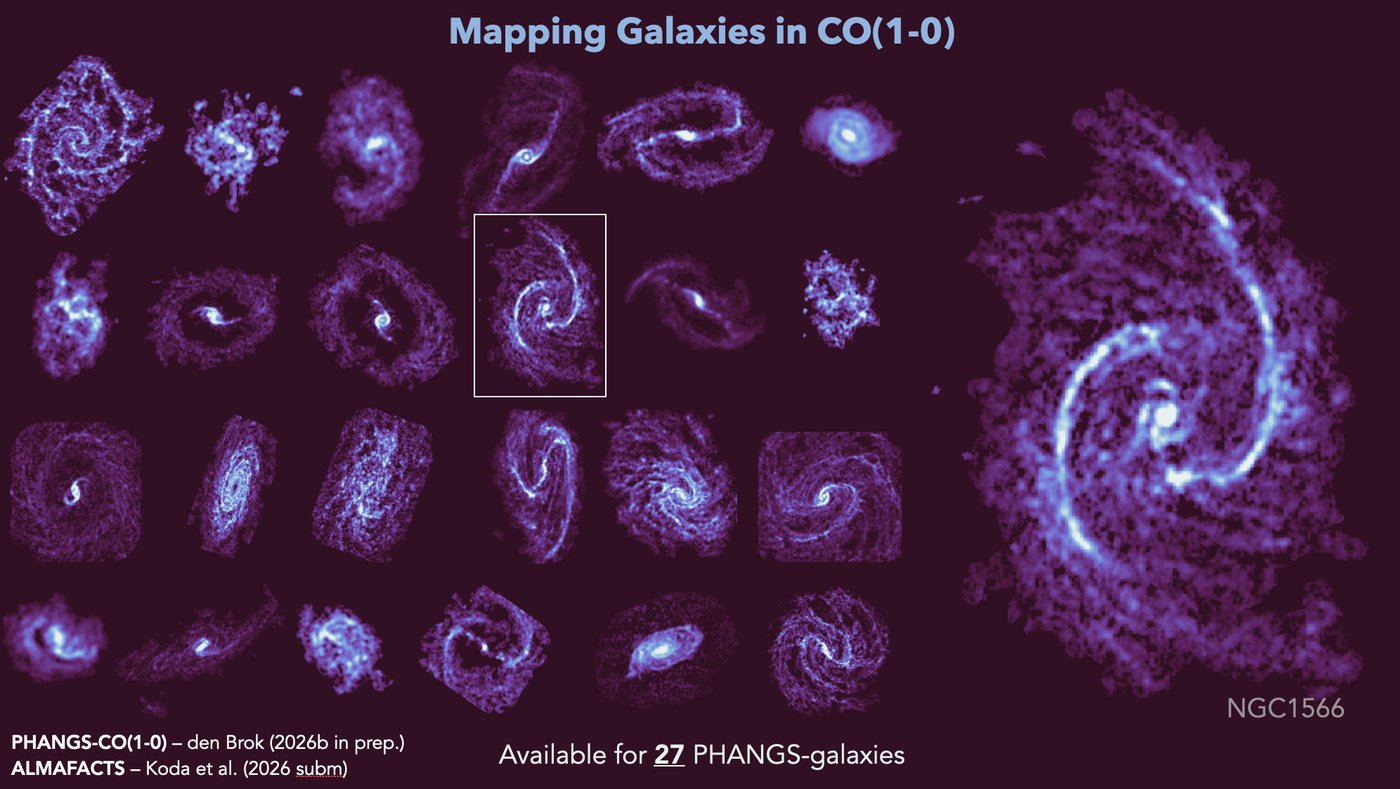
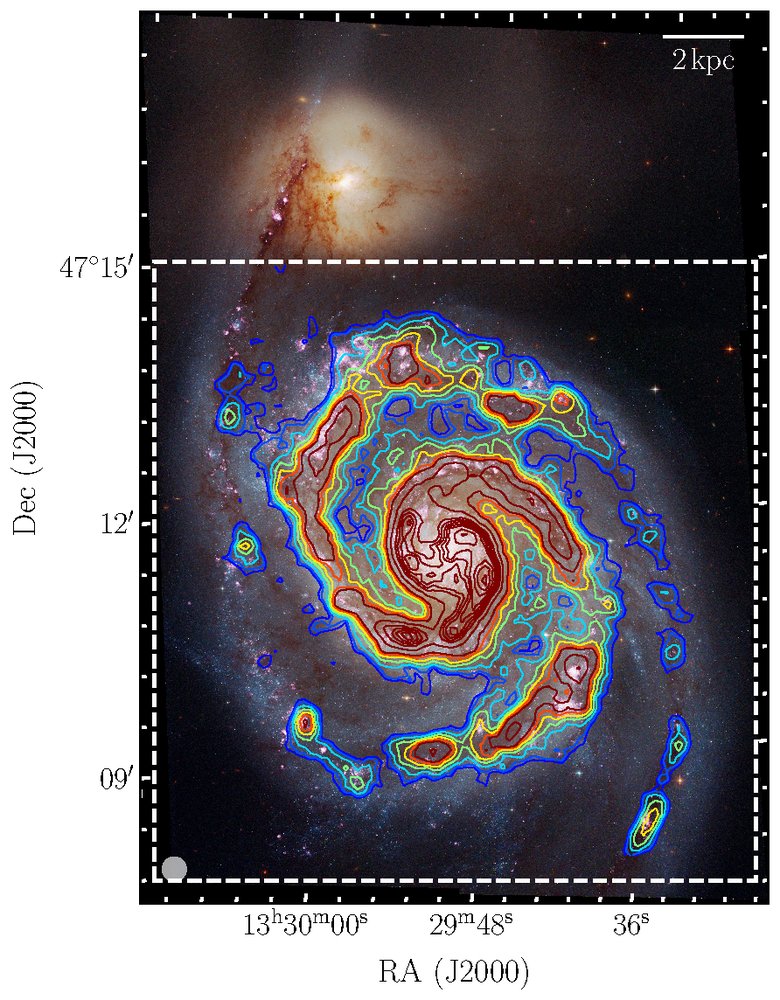
CO is our main tracer of molecular gas, but its brightest line is optically thick and reveals little about the gas itself. Its rarer isotopologues, such as 13CO and C18O, are fainter but far more transparent, so their line ratios tell us about the temperature, density and optical depth of the gas, and how much molecular gas hides behind a given CO brightness (the CO-to-H2 conversion factor). I led the analysis of CLAWS, a deep IRAM 30-m survey of the Whirlpool Galaxy (M51), and extended this work to M101 and to cloud-scale interferometric maps of M51. One key result: the conversion factor can drop by up to a factor of ten in galaxy centers.
Key papers
- CO isotopologue-derived molecular gas conditions and CO-to-H2 conversion factors in M51 den Brok, Jiménez-Donaire, Leroy et al. (2025)
- Wide-field CO isotopologue emission and the CO-to-H2 factor across the nearby spiral galaxy M101 den Brok, Bigiel, Chastenet et al. (2023)
- A CO isotopologue Line Atlas within the Whirlpool galaxy Survey (CLAWS) den Brok, Bigiel, Sliwa et al. (2022)
- Surveying the Whirlpool at Arcseconds with NOEMA (SWAN): III. 13CO/C18O ratio variations across the M51 galaxy Galić, Thorp, Bigiel et al. (2025)
- Application of Resolved Low-J Multi-CO Line Modeling with RADEX to Constrain the Molecular Gas Properties in the Starburst M82 Zhang, den Brok, Zhang et al. (2025)